Investigation of the Behavior of Nickel Impurity Atoms in the Silicon Lattice Based on First Principles
Abstract
This work presents a comprehensive theoretical and experimental study of the behavior of nickel impurity atoms in the silicon crystal lattice. The focus is on analyzing diffusion mechanisms, the energetic characteristics of interstitial nickel atoms, their interaction with defects and other impurities, as well as the formation of stable clusters within the crystal volume. First-principles quantum mechanical modeling was employed using the QuantumATK software, applying the Linear Combination of Atomic Orbitals (LCAO) method and the Local Density Approximation (LDA) exchange-correlation functional. Special attention was given to calculating the binding energy of nickel atoms in interstitial sites and estimating the activation energy for their migration along various crystallographic directions ([100] and [010]). The modeling results revealed that nickel atoms predominantly diffuse in interstitial positions with an activation energy around 0.31 eV, which aligns well with previously reported experimental data. It was found that interactions of nickel with oxygen, carbon impurities, and point defects have a minimal impact on diffusion processes. However, interactions with vacancies lead to the formation of stable nickel silicides and cause an increased concentration of nickel near the surface. The experimental part of the study confirmed the formation of nickel clusters under high-temperature treatments. Scanning Electron Microscopy (SEM), Secondary Ion Mass Spectrometry (SIMS), and Infrared (IR) microscopy revealed a high density and uniform distribution of clusters throughout the crystal volume. Cluster sizes ranged from 20 to 100 nm, with concentrations reaching approximately 1010 cm-3. These findings demonstrate that nickel acts as an effective gettering impurity, enhancing the electrophysical properties of silicon. The results provide valuable insights for optimizing the fabrication processes of high-efficiency silicon solar cells and microelectronic devices.
Downloads
References
B.K. Ismaylov, N.F. Zikrillayev, K.A. Ismailov, and Z.T. Kenzhaev, Physical Sciences and Technology, 10(1), 13 (2023). https://doi.org/10.26577/phst.2023.v10.i1.02
M.K. Bakhadyrkhanov and S.Z. Zaynobidinov, Semiconductors, 14, 412 (1980). (in Russian)
S.Z. Zaynabidinov and N.А. Turgunov, Uzbek Journal of Physics, 5(5), 371 (2003). (in Russian)
H. Kitagawa, Sol. Stat. Phenom. 71, 51 (2000). https://doi.org/10.4028/www.scientific.net/SSP.71.51
A.A. Istratov, P. Zhang, R.J. McDonald, A.R. Smith, M. Seacrist, J. Moreland, J. Shen, et al., Journal of Applied Physics, 97, 023505 (2005). https://doi.org/10.1063/1.1836852
J. Lindroos, D.P. Fenning, D.J. Backlund, E. Verlage, A. Gorgulla, S.K. Estreicher, H. Savin, and T. Buonassisi, Journal of Applied Physics, 113, 204906 (2013). http://dx.doi.org/10.1063/1.4807799
J. Lindroos, D. Sc. Thesis, “Copper-related light-induced degradation in crystalline silicon”, Aalto University, 2015.
H. Kitagawa, and Sh. Tanaka, Physica B: Condensed Matter, 273, 391 (1999). https://doi.org/10.1016/S0921-4526(99)00487-1
M.K. Bakhadyrkhanov, B.K. Ismaylov, S.A. Tachilin, K.A. Ismailov, and N.F. Zikrillaev, Semiconductor Physics, Quantum Electronics and Optoelectronics, 23(4), 361 (2020). https://doi.org/10.15407/spqeo23.04.361
B.K. Ismaylov, N.F. Zikrillayev, K.A. Ismailov, and Z.T. Kenzhaev, Semiconductor Physics, Quantum Electronics & Optoelectronics, 27(3), 294 (2024). https://doi.org/10.15407/spqeo27.03.294
Z.T. Kenzhaev, Kh.M. Iliev, K.A. Ismailov, G.Kh. Mavlonov, S.V. Koveshnikov, B.K. Ismaylov, and S.B. Isamov, Physical Sciences and Technology, 11(1), 13 (2024). https://doi.org/10.26577/phst2024v11i1a2.
K.A. Ismailov, N.F. Zikrillaev, B.K. Ismaylov, Kh. Kamalov, S.B. Isamov, and Z.T. Kenzhaev, J. Nano- Electron. Phys. 16(5), 05022 (2024). https://doi.org/10.21272/jnep.16(5).05022
Z.T. Kenzhaev, H.M. Iliev, V.B. Odzhaev, G.H. Mavlonov, V.S. Prosolovich, E.I Kosbergenov, B.K. Ismailov, et al., Surface Engineering and Applied Electrochemistry, 60(6), 851 (2024). https://doi.org/10.3103/S1068375524700467
N.A. Turgunov, Sh.K. Akbarov, N.B. Khaytimmetov, and R.M. Turmanova, J. Nano- Electron. Phys. 16(1), 01004 (2024). https://doi.org/10.21272/jnep.16(1).01004
I. Bayrambay, I. Kanatbay, K. Khayratdin, and S. Gulbadan, AIP Conference Proceedings, 2552, 060015 (2022). https://doi.org/10.1063/5.0129486
N.F. Zikrillaev, S.V. Koveshnikov, X.S. Turekeev, and B.K. Ismailov, Journal of Surface Investigation: X-ray, Synchrotron and Neutron Techniques. 18(1), 69 (2024). https://doi.org/10.1134/S102745102401021X
X.M. Iliyev, V.B. Odzhaev, S.B. Isamov, B.O. Isakov, B.K. Ismaylov, K.S. Ayupov, S.I. Hamrokulov, and S.O. Khasanbaeva, East Eur. J. Phys. (3), 363 (2023). https://doi.org/10.26565/2312-4334-2023-3-38
N.F. Zikrillaev, F.E. Urakova, A.R. Toshev, G.A. Kushiev, T.B. Ismailov, Y.A. Abduganiev, and N. Norkulov, East Eur. J. Phys. (1), 184 (2025). https://doi.org/10.26565/2312-4334-2025-1-18
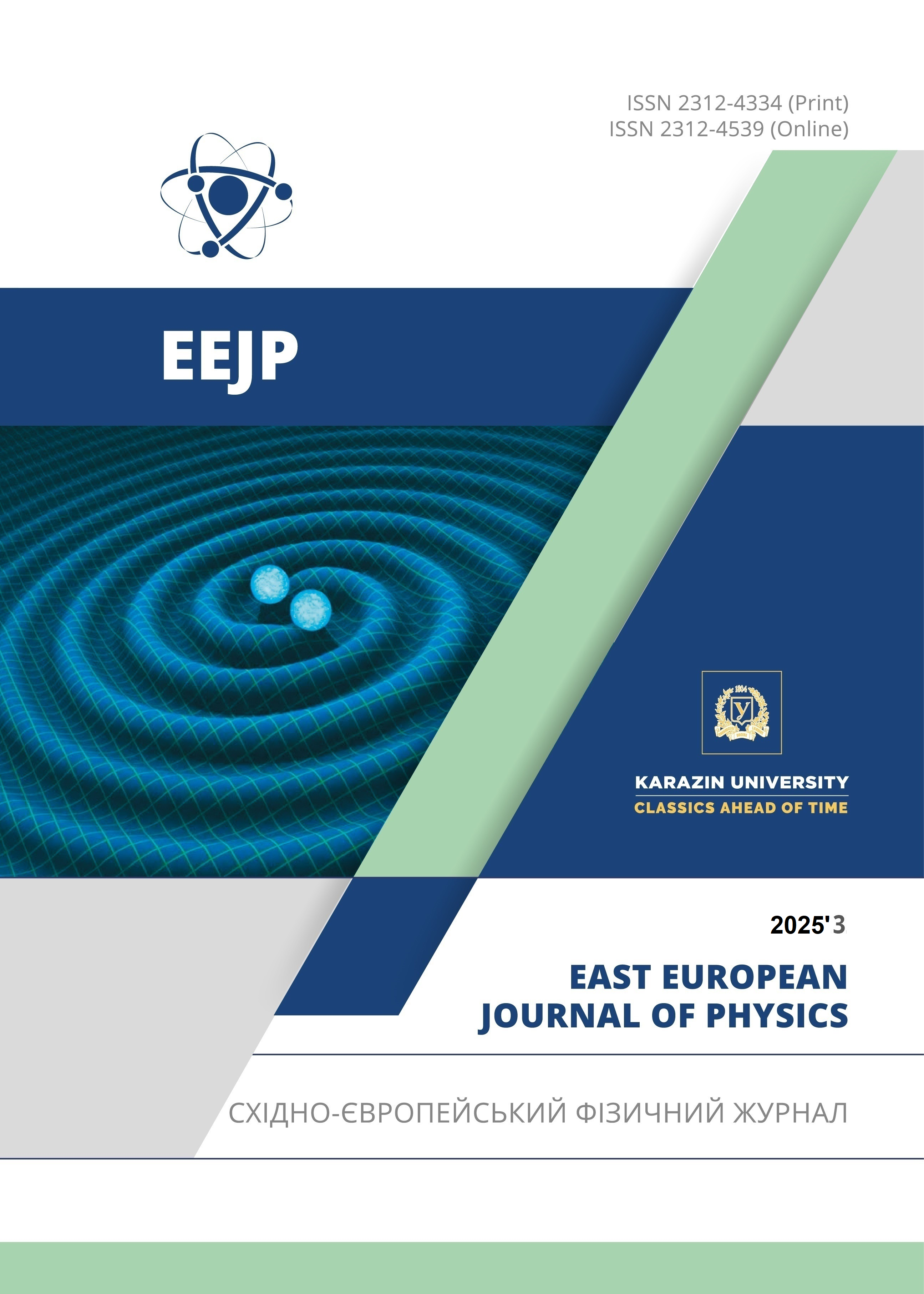
Copyright (c) 2025 Bayrambay K. Ismaylov, Kanatbay A. Ismailov, Nurulla F. Zikrillaev, Atabek E. Atamuratov, Sergey V. Koveshnikov, Zoir T. Kenzhaev, Makhkam M. Khalilloev, Parakhat K. Dilimbetov

This work is licensed under a Creative Commons Attribution 4.0 International License.
Authors who publish with this journal agree to the following terms:
- Authors retain copyright and grant the journal right of first publication with the work simultaneously licensed under a Creative Commons Attribution License that allows others to share the work with an acknowledgment of the work's authorship and initial publication in this journal.
- Authors are able to enter into separate, additional contractual arrangements for the non-exclusive distribution of the journal's published version of the work (e.g., post it to an institutional repository or publish it in a book), with an acknowledgment of its initial publication in this journal.
- Authors are permitted and encouraged to post their work online (e.g., in institutional repositories or on their website) prior to and during the submission process, as it can lead to productive exchanges, as well as earlier and greater citation of published work (See The Effect of Open Access).