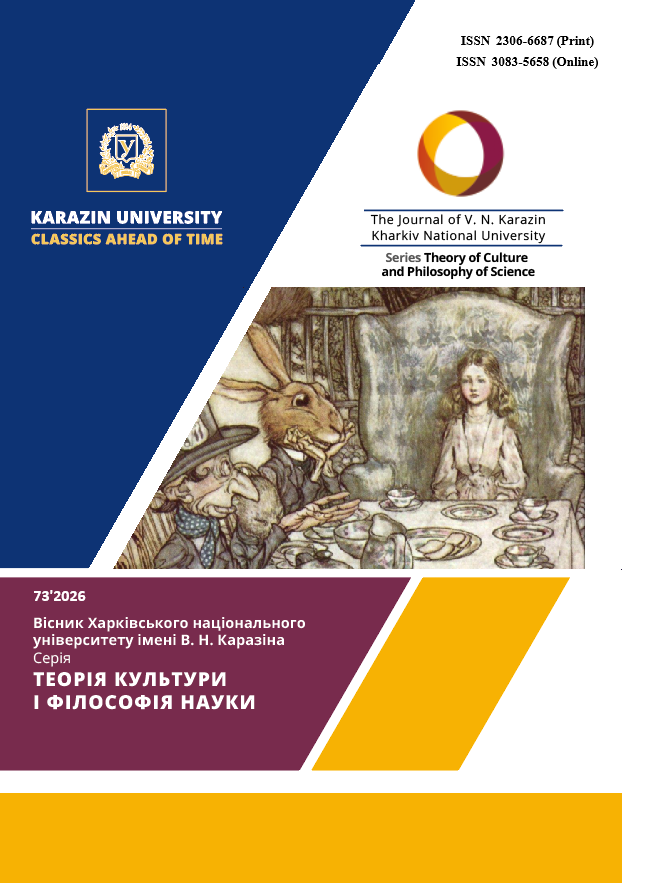
«THE RABBIT SENDS IN A LITTLE BILL»: BEING-WITH UNDER THE CONDITIONS OF THE LOSS OF COMMENSURABILITY
Abstract
The article addresses the socio-philosophical examination of being-with as a form of human existence that presupposes a certain commensurability between the subject, the body, social space, and the structures of interaction. The author investigates the conditions under which a shared world becomes possible, as well as the mechanisms through which this possibility is lost in situations of crisis. The central thesis holds that being-with cannot be reduced to the mere fact of physical presence or communication, but is grounded in a complex system of correspondences between the human being and the world of their social existence.
The fourth chapter of Lewis Carroll's Alice's Adventures in Wonderland serves as the primary material of the study, examined as a philosophical model of the breakdown of commensurability. It is shown that the crisis of being-with arises not only from conflict or communicative rupture, but also from the disruption of habitual correspondences between body and space, social role and person, presence and mutual understanding. Particular attention is given to the phenomenon of social recognition, the problem of embodiment, the functioning of roles in crisis situations, and the specific character of interaction under conditions of absent co-presence.
The article argues that social order is sustained not only by norms and institutions, but also by concealed structures of commensurability that ordinarily remain unnoticed. Their disruption renders visible the fundamental conditions of human coexistence. The analysis demonstrates that even goodwill, openness to interaction, and communicative receptiveness cannot guarantee the possibility of a shared world if the participants in interaction lose their capacity to remain commensurable with one another.
The conclusion is drawn that Carrollian nonsense functions not merely as a literary device, but as an instrument of philosophical analysis of social reality — one that allows the crisis of being-with to be understood not as an exceptional state, but as a mode of revealing the ontological and social preconditions of everyday existence.
Downloads
References
Agamben, G. (1998). Homo sacer: Sovereign power and bare life (D. Heller-Roazen, Trans.). Stanford University Press. (Original work published 1995)
Agamben, G. (2005). State of exception (K. Attell, Trans.). University of Chicago Press. (Original work published 2003)
Ahmed, S. (2004). The cultural politics of emotion. Routledge.
Arendt, H. (1958). The human condition. University of Chicago Press.
Bulut, T., & Almabrouk, N. (2020). The functions of puns in Alice’s Adventures in Wonderland. The Reading Matrix: An International Online Journal, 20(1), 172–185. https://www.readingmatrix.com/files/22-gb5e5b35.pdf
Carroll, L. (2009). Alice’s adventures in Wonderland and Through the looking-glass. Oxford University Press. (Original work published 1865/1871)
Chadwick-Joshua, J. (1987). Alice’s Adventures in Wonderland and Through the Looking-Glass: A Menippean assessment and rhetorical analysis of Carroll’s Alice books [Doctoral dissertation, Texas Woman’s University]. Texas Woman’s University Repository. https://twu-ir.tdl.org/items/cd077302-049b-4086-ba66-4f3fed9aa7ae
Deleuze, G. (1990). The logic of sense (M. Lester & C. Stivale, Trans.). Columbia University Press. (Original work published 1969)
Foucault, M. (1977). Discipline and punish: The birth of the prison (A. Sheridan, Trans.). Pantheon Books. (Original work published 1975)
Gadamer, H.-G. (2004). Truth and method (2nd rev. ed., J. Weinsheimer & D. G. Marshall, Trans.). Continuum. (Original work published 1960)
Heidegger, M. (1995). The fundamental concepts of metaphysics: World, finitude, solitude (W. McNeill & N. Walker, Trans.). Indiana University Press. (Original work published 1929/1930)
Kemp, M. F. (2011). Carrollian language arts & rhetoric: Dodgson’s quest for order [Master’s thesis, University of Tennessee at Chattanooga]. UTC Scholar. https://scholar.utc.edu/theses/39/
Levinas, E. (1969). Totality and infinity: An essay on exteriority (A. Lingis, Trans.). Duquesne University Press. (Original work published 1961)
Merleau-Ponty, M. (1962). Phenomenology of perception (C. Smith, Trans.). Routledge. (Original work published 1945)
Ricoeur, P. (1981). Hermeneutics and the human sciences: Essays on language, action and interpretation (J. B. Thompson, Ed. & Trans.). Cambridge University Press. (Original work published 1969–1975)
Wollner, A. (2009). Doubletalk in Alice in Wonderland. The Victorian Web. https://victorianweb.org/authors/carroll/woolner8.html (Original work published 2004)