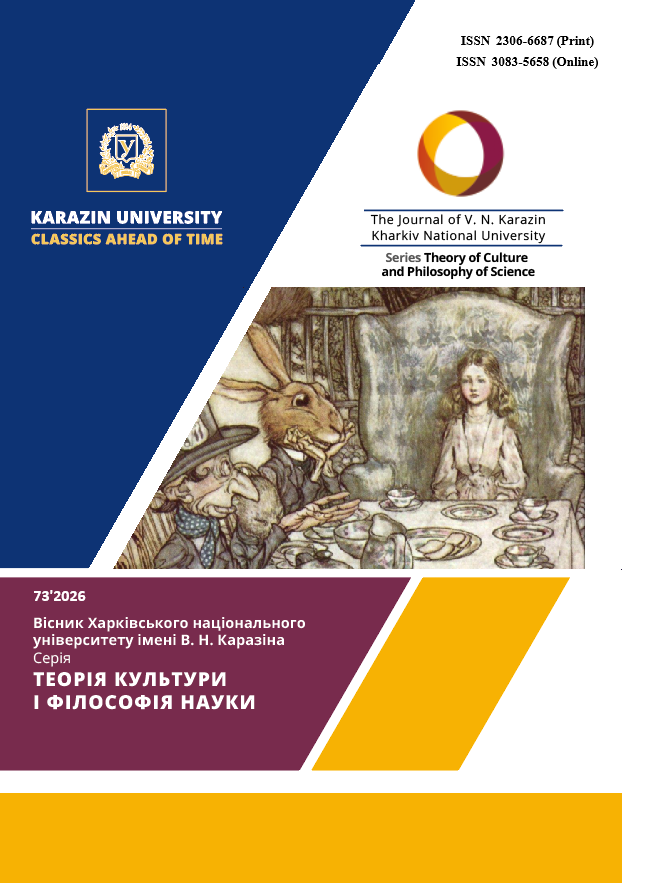
«A CAUCUS-RACE AND A LONG TALE»: DODO, THE SOPHISTS, AND THE RHETORIC OF A WET WORLD
Abstract
The article offers a philosophical analysis of Chapter Three of Lewis Carroll’s Alice’s Adventures in Wonderland as a model of the rhetorical production of social reality. It explores the relationship between language, collective order, and meaning in a situation where communication ceases to function exclusively as a mode of representation and acquires the capacity to organize social interaction directly. The central thesis of the study is that, in Wonderland, rhetoric functions not as a vehicle for transmitting pre-given meaning but as an autonomous mechanism for producing procedures, forms of community, and symbolic regimes of recognition.
Particular attention is paid to those episodes in the chapter where language demonstrates its productive power. It is shown that the Mouse’s “dry” lecture models a specific form of discursive ordering in which speech claims the ability to organize not only meaning but bodily reality itself. The Caucus-Race is interpreted as a ritual procedure in which rules do not precede action but emerge through the very process of enactment. Particular emphasis is placed on the ways collective order is sustained through repetition, participation, and the performative reproduction of shared practices, even in the absence of stable criteria of truth or success. The thimble-awarding ceremony is examined as a model of the symbolic production of value, where the status of an object is determined not by its intrinsic properties but by the ritual of public recognition. Attention is also given to the tale/tail episode, in which the language game moves beyond the level of semantics and assumes a spatial and visual form. It is demonstrated that nonsense here ceases to function merely as linguistic misunderstanding and instead reveals the material dimension of language, where meaning emerges through the interaction of word, image, and the spatial organization of the text.
It is argued that Chapter Three of Alice’s Adventures in Wonderland offers a philosophically relevant
model of social order that emerges through ritual, repetition, symbolic recognition, and collective participation. The article concludes that rhetoric in Carroll’s work functions not as an auxiliary instrument of communication but as one of the fundamental conditions of communal existence. This reading makes it possible to approach Wonderland not merely as a literary text of nonsense but as a unique laboratory for investigating the mechanisms through which human communities produce and sustain their own social reality.
Downloads
References
Ahmed S. The cultural politics of emotion / S. Ahmed. – London : Routledge, 2004. – 256 p.
Alice in Wonderland: Experimental jurisprudence on the internal point of view / Roversi C. et al. Jurisprudence. An International Journal of Legal and Political Thought. 2023. Vol. 14, Issue 2. pp. 143–170. DOI: https://doi.org/10.1080/20403313.2022.2109884
Baudrillard J. Simulacra and simulation / transl. by S. F. Glaser. Ann Arbor : University of Michigan Press, 1994. 164 p.
Bulut, T., & Almabrouk, N. (2020). The functions of puns in “Alice’s Adventures in Wonderland”. The Reading Matrix: An International Online Journal, 20(1), 172–185. https://www.readingmatrix.com/files/22-gb5e5b35.pdf
Carroll L. Alice’s adventures in Wonderland and Through the looking-glass. Oxford : Oxford University Press, 2009. 304 p.
Chadwick-Joshua, J. (1987). “Alice’s Adventures in Wonderland” and “Through the Looking-Glass”: A Menippean assessment and rhetorical analysis of Carroll’s Alice books [Doctoral dissertation, Texas Woman’s University]. Texas Woman’s University Repository. https://twu-ir.tdl.org/items/cd077302-049b-4086-ba66-4f3fed9aa7ae
Deleuze G. The logic of sense / transl. by M. Lester, C. Stivale. New York : Columbia University Press, 1990. 344 p.
Faranda A. Alice’s Adventures in Wonderland : A journey into the unconscious, a shamanic journey. Blue Gum. 2022. Vol. 9. pp. 42–45. Режим доступу: https://www.ub.edu/dpfilsa/Blue_Gum/BlueGum_Vol9/9_Faranda%20Blue%20Gum %209%202022.pdf (дата звернення: 23.05.2026).
Foucault M. Discipline and punish : The birth of the prison / transl. By A. Sheridan. New York : Pantheon Books, 1977. 333 p.
Foucault M. The archaeology of knowledge / transl. by A. M. Sheridan Smith. New York : Pantheon Books, 1972. 245 p.
Gadamer H.- G. Truth and method / transl. by J. Weinsheimer, D. G. Marshall ; 2nd rev. ed. London : Continuum, 2004. 601 p.
Hadot P. Philosophy as a way of life : Spiritual exercises from Socrates to Foucault / ed. by A. I. Davidson; transl. by M. Chase. Oxford : Blackwell, 1995. 320 p.
Hadot P. What is ancient philosophy? / transl. by M. Chase. Cambridge, MA : Harvard University Press, 2002. 384 p.
Heidegger M. The fundamental concepts of metaphysics : World, finitude, solitude / transl. by W. McNeill, N. Walker. Bloomington : Indiana University Press, 1995. 365 p.
Kemp, M. F. (2011). Carrollian language arts & rhetoric: Dodgson’s quest for order [Master’s thesis, University of Tennessee at Chattanooga]. UTC Scholar. https://scholar.utc.edu/theses/39/
Kristeva J. Powers of horror: An essay on abjection / trans. by L. S. Roudiez. New York : Columbia University Press, 1982. 219 p.
Lyotard J.- F. The postmodern condition : A report on knowledge / transl. By G. Bennington, B. Massumi. Minneapolis : University of Minnesota Press, 1984. 144 p.
Massumi B. Parables for the virtual: Movement, affect, sensation / B. Massumi. – Durham : Duke University Press, 2002. – 317 p.
Merleau-Ponty M. Phenomenology of perception / M. Merleau-Ponty ; trans. by C. Smith. – London : Routledge, 1962. – 466 p.
Meyer M. Problématologie : Philosophie, science et langage. Paris : Presses Universitaires de France, 1986. 128 p.
Nietzsche F. Thus spoke Zarathustra / transl. by R. J. Hollingdale. London : Penguin Books, 1961. 352 p.
Ricoeur P. Hermeneutics and the human sciences : Essays on language, action and interpretation / ed. and transl. by J. B. Thompson. Cambridge : Cambridge University Press, 1981. 314 p.
Ricoeur P. Time and narrative : in 3 vols. / transl. by K. McLaughlin, D. Pellauer. Chicago : University of Chicago Press, 1984–1988.
Sfetcu N. Alice’s Adventures in Wonderland – Philosophical perspectives. Index Academic. 2025. Vol. 1. pp. 1–11. DOI: https://doi.org/10.58679/IA55823
Turner V. The ritual process : Structure and anti-structure. Chicago : Aldine Publishing, 1969. 213 p.
Wittgenstein L. Philosophical investigations / transl. by G. E. M. Anscombe, P. M. S. Hacker, J. Schulte ; rev. 4th ed. Oxford : Wiley-Blackwell, 2009. 592 p.
Wollner, A. (2009). Doubletalk in Alice in Wonderland. The Victorian Web. https://victorianweb.org/authors/carroll/woolner8.html (Original work written 2004)