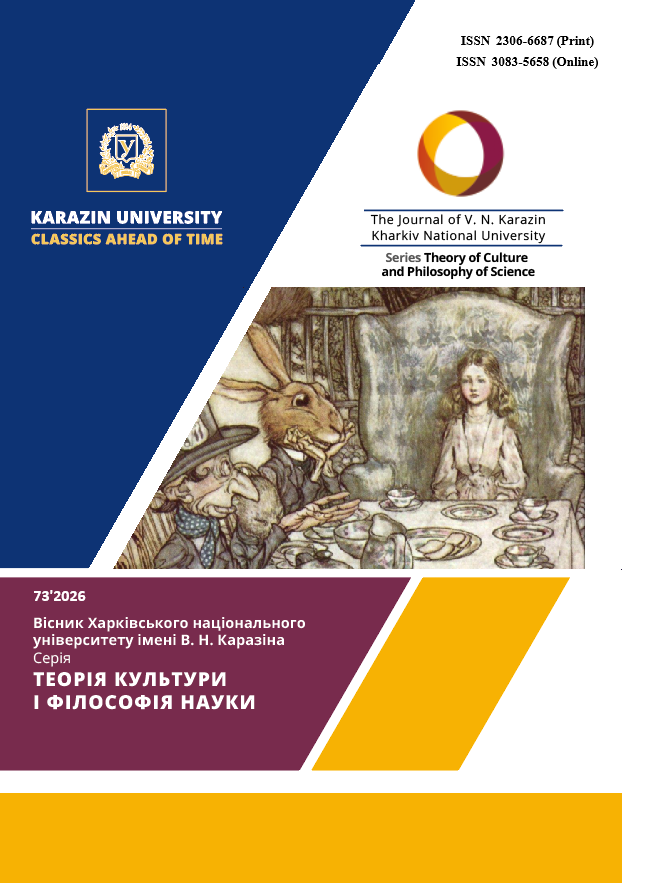
«ADVICE FROM A CATERPILLAR»: ON BOTH SIDES OF THE MUSHROOM
Abstract
The article is devoted to investigating the rhetorical mechanisms behind the problematization of personal identity. The underlying premise of the study is that the question of identity does not necessarily function as a means of acquiring knowledge about the subject. In certain discursive situations, it may perform the opposite function: subverting the foundations of self-determination, shifting identity into a mode of continuous revision, and generating a space of uncertainty within which any answer proves temporary and fundamentally incomplete.
The study examines the relationship between rhetoric, skepticism, and practices of self-description. Particular attention is paid to how memory, embodiment, and speech–traditionally regarded as the foundations of personal identity–can become sources of its problematization. It is shown that self-identity emerges not as a finished state or a hidden essence, but as a process of interpretation that is constantly renewed within situations of communicative interaction.
The methodological framework of the work is based on a combination of rhetorico-critical analysis, a hermeneutic approach, and problematology. The theoretical context is informed by the concept of narrative identity, the skeptical tradition, and contemporary research into the rhetorical nature of self-determination. Special emphasis is placed on analyzing the question as an independent philosophical event capable of not
only opening up possibilities for a response but also demonstrating the limits of any definitive definition
It is argued that uncertainty in matters of identity is not a consequence of a lack of information, but a structural characteristic of the process of self-understanding itself. In this context, rhetoric appears not as an auxiliary means of representing philosophical ideas, but as a mode of their direct production. Such an approach allows identity to be viewed not as an object of cognition, but as an open process unfolding between the attempt at self-determination and the impossibility of its final completion.
Downloads
References
Aristotle. (2010). Rhetoric (W. R. Roberts, Trans.). Cosimo Classics (Original work written c. 350 BCE)
Bulut, T., & Almabrouk, N. (2020). The functions of puns in “Alice’s Adventures in Wonderland”. The Reading Matrix: An International Online Journal, 20(1), 172–185. https://www.readingmatrix.com/files/22-gb5e5b35.pdf
Carroll, L. (2009). Alice’s adventures in Wonderland and Through the looking-glass. Oxford University Press.
Chadwick-Joshua, J. (1987). “Alice’s Adventures in Wonderland” and “Through the Looking-
Glass”: A Menippean assessment and rhetorical analysis of Carroll’s Alice books [Doctoral dissertation, Texas Woman’s University]. Texas Woman’s University Repository. https://twu-ir.tdl.org/items/cd077302-049b-4086-ba66-4f3fed9aa7ae
Deleuze, G. (1990). The logic of sense (M. Lester & C. Stivale, Trans.). Columbia University Press.
Gadamer, H.-G. (2004). Truth and method (2nd rev. ed., J. Weinsheimer & D. G. Marshall, Trans.). Continuum.
Heidegger, M. (1995). The fundamental concepts of metaphysics: World, finitude, solitude (W. McNeill & N. Walker, Trans.). Indiana University Press.
Hume, D. (1978). A treatise of human nature. Oxford University Press. (Original work published 1739)
Kemp, M. F. (2011). Carrollian language arts & rhetoric: Dodgson’s quest for order [Master’s thesis, University of Tennessee at Chattanooga]. UTC Scholar. https://scholar.utc.edu/theses/39/
Locke, J. (1997). An essay concerning human understanding. Penguin Books. (Original work published 1689)
Merleau-Ponty, M. (1962). Phenomenology of perception (C. Smith, Trans.). Routledge.
Meyer, M. (1986). Problématologie: Philosophie, science et langage. Presses Universitaires de France.
Nietzsche, F. (1961). Thus spoke Zarathustra (R. J. Hollingdale, Trans.). Penguin Books.
Ricoeur, P. (1981). Hermeneutics and the human sciences: Essays on language, action and interpretation (J. B. Thompson, Ed. & Trans.). Cambridge University Press.
Ricoeur, P. (1984–1988). Time and narrative (Vols. 1–3, K. McLaughlin & D. Pellauer, Trans.). University of Chicago Press.
Roversi, C., Ubertone, M., Villani, C., d’Ascenzo, S., & Lugli, L. (2023). Alice in Wonderland: Experimental jurisprudence on the internal point of view. Jurisprudence: An International Journal of Legal and Political Thought, 14(2), 143–170. https://doi.org/10.1080/20403313.2022.2109884
Sextus Empiricus. (1933). Outlines of pyrrhonism (R. G. Bury, Trans.). Harvard University Press. (Original work published ca. 200 CE)
Sfetcu, N. (2025). Alice’s Adventures in Wonderland – Philosophical perspectives. Index Academic, 1, 1–11. https://doi.org/10.58679/IA55823
Wittgenstein, L. (2009). Philosophical investigations (Rev. 4th ed., G. E. M. Anscombe, P. M. S. Hacker, & J. Schulte, Trans.). Wiley-Blackwell.
Wollner, A. (2009). Doubletalk in Alice in Wonderland. The Victorian Web. https://victorianweb.org/authors/carroll/woolner8.html (Original work written 2004)