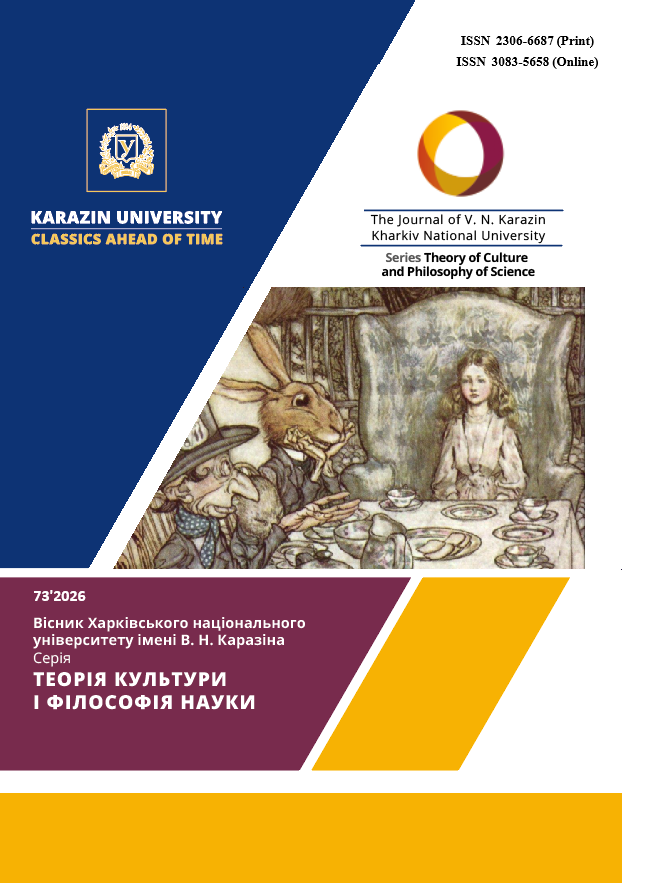
THE LIMINALITY OF GAME EXPERIENCE: «DOWN THE RABBIT-HOLE» AS A MODEL FOR THE TRANSITION TO THE DIGITAL WORLD
Abstract
The article is devoted to a philosophical analysis of the liminality of video game experience as a distinctive mode through which the subject enters the digital world. The study is based on the premise that the figure of Alice, created by Lewis Carroll, together with the motif of "falling down the rabbit hole," can serve as a conceptual model for the transition between different ontological modes of experience. From this perspective, the journey into Wonderland represents a structure that describes the loss of established cognitive coordinates, the acquisition of new modes of orientation, and the gradual constitution of the subject within a virtual environment whose rules become intelligible only through interaction.
The theoretical framework of the study combines the concept of liminality developed by Arnold van Gennep and Victor Turner, Maurice Merleau-Ponty's phenomenology of experience, Hans-Georg Gadamer's hermeneutic conception of play, and contemporary contributions to game studies concerned with the phenomenology of video games, the ergodicity of digital texts, and immersion in virtual worlds (Espen Aarseth, Jesper Juul, Miguel Sicart, and Jan Valo). Since the gaming process transforms the nature of experience, the ways in which players orient themselves in the world, and the principles underlying their interaction with it, the approaches discussed above provide grounds for understanding video games as spaces in which players temporarily move beyond habitual modes of perceiving and engaging with reality.
The article further examines the transition into the virtual world as an ontological event involving a shift in the mode of presence, a transformation of subjectivity, and the appropriation of the normative structures that govern the digital environment. The figure of Alice performs a heuristic function by representing a universal structure of entering a world organized according to different principles of spatiality, temporality, causality, and meaning-making. Accordingly, liminality is interpreted as a constitutive condition of video game experience rather than merely as a characteristic of the transition between two states.
The scientific novelty of the study lies in its philosophical conceptualization of Alice as a model of digital liminality and in its justification of applying the anthropological theory of liminality to the analysis of video games. The proposed approach expands the conceptual framework of the philosophy of digital culture by opening new perspectives for understanding video game experience through the categories of ontology, phenomenology, subjectivity, and the spatiotemporal organization of digital worlds.
Downloads
References
Bakels, J.-H. (2021). Steps towards a Phenomenology of Video Games—Some Thoughts on Analyzing Aesthetics and Experience. Eludamos: Journal for Computer Game Culture, 11(1), 71-97. https://doi.org/10.7557/23.6354
Van Gennep A. The Rites of Passage. Chicago : University of Chicago Press, 1960. 256 p.
Turner V. W. The Ritual Process: Structure and Anti-Structure. The Lew/s Hen/y Morgan Lectures | The University of Rochester, Rochester, New York, 1977. 213 p.
Merleau-Ponty M. Phenomenology of Perception. London : Routledge & Kegan Paul, 2002. 544 p.
Gadamer H.-G. Truth and Method. 2nd rev. ed. London : Continuum, 2004. 601 p.
Huizinga J. Homo Ludens: A Study of the Play-Element in Culture. Boston : Beacon Press, 1960. 214 p.
Aarseth E. J. Cybertext: Perspectives on Ergodic Literature. Baltimore : Johns Hopkins University Press, 1997. 203 p.
Juul J. Half-Real: Video Games between Real Rules and Fictional Worlds. Cambridge, MA : MIT Press, 2011. 244 p.
Galloway A. R. Gaming: Essays on Algorithmic Culture. Minneapolis : University of Minnesota Press, 2006. 160 p.
Austin J. L. How to Do Things with Words. 2nd ed. Cambridge : Harvard University Press, 1975. 168 p.
Sicart M. Play Matters. Cambridge, The MIT Press, 2017. 176 p.
Gualeni S. Virtual Worlds as Philosophical Tools: How to Philosophize with a Digital Hammer. Basingstoke : Palgrave Macmillan, 2015. 194 p.
Vahlo J. An Enactive Account of the Autonomy of Videogame Gameplay. Game Studies. 02.02.2017. URL: https://gamestudies.org/1701/articles/vahlo (Accessed: 11.03.2026).
Crick T. The Game Body: Toward a Phenomenology of Contemporary Video Gaming // Games and Culture. 2001. Vol. 6, No. 3. P. 259–269.
Farrow R., Iacovides I. “In the Game”? Embodied Subjectivity in Gaming Environments // Proceedings of the 6th International Conference on the Philosophy of Computer Games: The Nature of Player Experience. Madrid, 2012. 11 p.
tang S. “This Action Will Have Consequences”: Interactivity and Player Agency. Game Studies. 14.07.2026. URL: https://gamestudies.org/1901/articles/stang (Accessed: 11.03.2026)..
Michailidis L., Balaguer-Ballester E., He X. Flow and Immersion in Video Games: The Aftermath of a Conceptual Challenge // Frontiers in Psychology. 2018. Vol. 9. Article 1682. https://doi.org/10.3389/fpsyg.2018.01682
Farca G. Playing Dystopia: Nightmarish Worlds in Video Games and the Player’s Aesthetic Response. Bielefeld : transcript Verlag, 2018. 434 p.
Picucci M. A. The Impact and Influence of Carroll’s World of Alice on Video Game Design // ATINER Conference Paper Series. No. HUM2014-0895. Athens : Athens Institute for Education and Research, 2014. 14 p.
Folléa C. Videogames’ Specific Forms of Immersion into the Past, Present, and Future: Experiencing Progress in American McGee’s Alice (2000) and Alice: Madness Returns (2011) // Polysèmes. 2020. Vol. 23. https://doi.org/10.4000/polysemes.6446