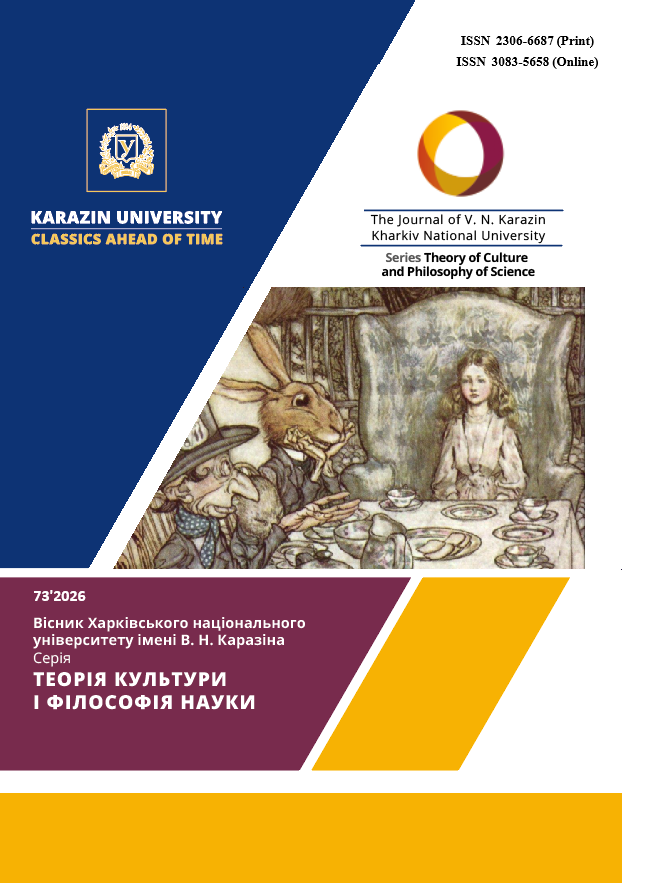
ANAMORPHOSIS AS MENTAL OPTICS AND NARRATIVE MODEL: FROM VISUAL ART TO LEWIS CARROLL’S ALICE
Abstract
The article is devoted to cultural-philosophical reflections on the phenomenon of anamorphosis as a multilevel model for organizing visual, cognitive, and narrative experience, examined through the example of Lewis Carroll’s Alice duology. It is demonstrated that the concept of anamorphosis, traditionally employed to designate an artistic technique of creating optical illusions associated with perspectival distortion, has transcended the boundaries of the history and theory of visual arts within contemporary humanities, acquiring the status of a universal epistemic and cultural concept. Drawing upon the intersection of several theoretical approaches to anamorphosis – including the art-historical perspectives of Jurgis Baltrušaitis and Erwin Panofsky, the psychoanalytic reflections of Jacques Lacan and Slavoj Žižek, and the media theories of Lambert Wiesing and Dominik Finkelde – the article traces the evolution of the concept of anamorphosis from an optical illusion to a model of vision, thought, and interpretation.
The aim of the study is to identify the specific features of anamorphosis as a mode of constructing the mental optics and narrative model of Lewis Carroll’s philosophical fairy-tale duology Alice’s Adventures in Wonderland and Through the Looking-Glass. It is argued that the shift of perspective constitutes one of the fundamental principles organizing the artistic universe of the two books. The article analyzes their principal anamorphic structures and episodes: Alice’s fall down the rabbit hole as an inversion of the habitual image of reality; the heroine’s changes in size as a model of perceptual relativity; the figure of the Cheshire Cat as an example of the disruption of established cognitive schemes; the Mad Tea Party as a collision of alternative logical systems; and the opening poem in Through the Looking-Glass, which can be read only with the aid of a mirror. It is argued that anamorphosis in Carroll’s work functions not as a narrative device but rather as a mode of generating meaning through the constant displacement of interpretive coordinates. The proposed model makes it possible to establish connections between classical forms of anamorphic art and contemporary cultural-philosophical concepts. The article also outlines the reception of Carroll’s anamorphic principle of narrative construction in Ludwig Wittgenstein’s analytical philosophy of language games and in Gilles Deleuze’s Logic of Sense. It is concluded that anamorphosis may be understood on three interconnected levels: as a visual device, as mental optics, and as a narrative model. Taken as a whole, it functions as one of the key cognitive metaphors of contemporary culture, in which the change of perspective becomes a fundamental condition for the emergence of new forms of vision, understanding, and meaning-making.
Downloads
References
Albul, Yu. Ye. (2017). Philosophical subtext in Lewis Carroll's Alice in Wonderland (based on English, Italian, and Ukrainian materials). Young Scientist. No. 11. Р. 174–177. (In Ukrainian).
Ivanitska, T. I., Kharkhalis, Y. Y., Luchyshyn, N. I. (2023). “Alice in Wonderland” by Lewis Carroll: What mental disorders do the characters of the famous children's book hide?회의 절차: Theoretical and practical aspects of modern scientific research. Collection of Scientific Papers “ΛΌГOΣ” (November 24, 2023; Seoul, South Korea). Р. 231–236. DOI: https://doi.org/10.36074/logos-24.11.2023.69. (In Ukrainian).
Carroll, L. (2022). Alice Through the Looking-Glass: A Story / Alice in Wonderland: A Story / trans. from English by Valentin Kornienko, edited by Ivan Malkovich; foreword by Oksana Zabuzhko; artist Vladislav Yerko. 12th edition. Kyiv: A-BA-BA-GA-LA-MA-GA. 264 p. (Books that have overcome time). (In Ukrainian).
Bara, I., Darda, K., Ramsey, R., & Cross, E. S. (2026). Algorithmic Aesthetics: Cognitive Perspectives on AI-Generated Visual Art. iScience. Vol. 28. No. 11. P. 1–11. DOI: https://doi.org/10.1016/j.isci.2026.113826.
Baltrušaitis, J. (1977). Anamorphic art. New York, NY: Harry N. Abrams. 182 p.
Blom, J. D. (2016). Alice in Wonderland syndrome: a systematic review. Neurology: Clinical Practice. Vol. 6. No. 3. P. 259–270. DOI: https://doi.org/10.1212/CPJ.0000000000000251.
Boyle, J. E. (2010). Anamorphosis in Early Modern Literature: Mediation and Affect. New York, NY: Routledge. 176 p. (Literary and Scientific Cultures of Early Modernity).
Cabiati A. (2026). Dreaming (and) Insanity: Alice's Adventures in Wonderland through the Looking-Glass of Victorian Psychology. Vol. 3. Issue 4. P. 539–565. https://doi.org/10.1017/S106015032510020X.
Carroll, L. (2021). Alice's Adventures in Wonderland and Through the Looking-Glass. Montreal: Universitas Press, 2021. 270 p.
Deleuze, G., Guattari, F. (1991). Qu'est-ce que la philosophie? Paris: Minuit, 1991. 206 p.
Derrida, J. (2021). Thinking Out of Sight: Writings on the Arts of the Visible (J. Masó, G. Michaud, J. Bassas (Eds.)., L. Milesi & I. McLeod, Transl.) Chicago: University of Chicago Press. 328 p. (The France Chicago Collection).
Finkelde, D. (2020). Anamorphosis and subjectivity in the space of reasons: On the Diffraction Laws of Consciousness and Reality in Hegel and Lacan. Philosophy Today. Vol. 64. No. 1. P. 7–19. DOI: https://doi.org/10.5840/philtoday202047323.
Geal, R. (2019). Anamorphic Authorship in Canonical Film Adaptation: A Case of Shakespearean Films. London: Palgrave Macmillan. 259 p. (Palgrave Studies in Adaptation and Visual Culture).
Grau, O., Hoth, J., & Wandl-Vogt, E. (Eds.). (2019). Digital Art Through the Looking Glass: New Strategies for Archiving, Collecting and Preserving in Digital Humanities. Krems: Edition Donau-Universität Krems. 320 p.
Hansford, D. & Collins, D. (2007). Anamorphic 3D Geometry. Computing. Vol. 79. Issue 2–4. P. 211–223. DOI: https://doi.org/10.1007/s00607-006-0199-6.
Hurter, C., Carbon, C.-C., Martino, M., & Rogowitz, B. E. (2026). Art, Visual Illusions, and Data Visualization. (Dagstuhl Seminar 24301). In Dagstuhl Reports. Vol. 14. No. 7. P. 81–114. (Schloss Dagstuhl – Leibniz-Zentrum für Informatik). DOI: https://doi.org/10.4230/DagRep.14.7.81.
Kittler, F. (2010). Optical Media. Cambridge, UK: Polity, 332 p.
Kozii, O. (2024). Expressive Graphics as a Component of the Linguistic Picture of the World in Lewis Carroll's Fairy Tale “Alice's Adventures in Wonderland”. Astraea. Vol. 5. No. 1. P. 53–70. DOI: https://doi.org/10.34142/astraea.2024.5.1.03.
Lambert, F. (2014). Images in Distortions: From Anamorphosis to Conformal Mappings. International Journal of the Image. Vol. 4. No. 4. P. 63–70.
Lacan, J. (1998). The Seminar of Jacques Lacan: The Four Fundamental Concepts of Psychoanalysis (Book XI). (Miller, J.-A., Ed., A. Sheridan, Trans.). Revised ed. New York, NY: W. W. Norton & Company. 304 p.
Lazzaro, P. D., Murra, D., & Vitelli, P. (2019). The İnterdisciplinary Nature of Anamorphic İmages in A Journey Through Art, History and Geometry. Journal of Mathematics and The Arts. Vol. 13. No. 4. P. 353–368. DOI: https://doi.org/10.1080/17513472.2018.1506627.
Leong, W. Y. (2026). AI-Driven Optical Illusions: Innovations in Perceptual Art and Design. Innovation on Design and Culture. Vol. 4. Issue 1. P. 1–14. https://doi.org/10.35745/idc2026v04.01.0001.
Manovich, L. (2020). Cultural analytics. Cambridge, MA: MIT Press. 336 p.
Musorrafiti, D. (2024). István Orosz on Impossible Objects & Anamorphosis. Retrofuturista: Where Past and Future Collide in Music, Art, and Film. Retrieved from https://retrofuturista.com/istvan-orosz-on-impossible-objects-anamorphosis/.
Nicholas of Cusa. (2001). De Beryllo (On the Beryl / Eye-glass). In: Complete Philosophical and Theological Treatises. Vol. II. Transl. by J. Hopkins. Minneapolis, 2001. Publisher, A. J. Banning Press, P. 791–838.
Orosz, I. (1999). The Angle of Our Vision: About and A Propos Anamorphosis. Budapest: Balassi Kiadó, 143 p.
Pagliano, A. (2024). Dual View Anamorphosis. In Geometries of Anamorphic Illusions. New York, NY: Springer. P. 43–53. DOI: https://doi.org/10.1007/978-3-031-47246-6_5.
Panofsky, E. (1997). Perspective as symbolic form. (Reprinted). New York: Zone Books. 200 p.
Peterson, A. (2026). A New Humane Lesson in Lewis Carroll’s Alice’s Adventures in Wonderland (1865) and Through the Looking-Glass (1872). Victorian Literature and Culture. Vol. 53. Issue 3. P. 416–444. DOI: https://doi.org/10.1017/S1060150325000129.
Russo, E. (2018). Methodologies used in the literature on De Beryllo. In: Russo, E. The Philosophical-Theological Method of Nicholas of Cusa. In His De Beryllo. Salerno: Anno Accademico, Università Degli Studi Di Salerno. Р. 37–48.
Sanna, A. (Ed.) (2022). Alice in Wonderland in Film and Popular Culture. London: Palgrave Macmillan. 346 p.
Sfetcu, N. (2026). Alice's Adventures in Wonderland – Philosophical Perspectives. Index Academic. Vol. I. P. 1–11. DOI: https://doi.org/10.58679/ia55823.
Vignola, P. (2015). Alice Beyond the Selfie. To be worthy of what happens to her. La Deleuziana. No. 2. Alice And The Mirror. P. 1–9.
Wiesing, L. (2016). The Visibility of the Image: History and Perspectives of Formal Aesthetics (N. A. Roth, Trans.). London: Bloomsbury Academic. 280 p.
Žižek, S. (1991). Looking Awry: An Introduction to Jacques Lacan through Popular Culture. Cambridge, MA: MIT Press. 200 p.
Žižek, S. (2009). The Parallax View. Reprint. (Short Circuits). Cambridge, MA: The MIT Press. 444 p.
Žukauskienė, O. (2026). The Rationality of the Irrational. Jurgis Baltrušaitis’s Contribution to the History of Anamorphoses. (Anamorphoses and depraved perspectives). Sovijus. Interdisciplinary studies of culture. Vol. 13. No. 1. P. 144–161.