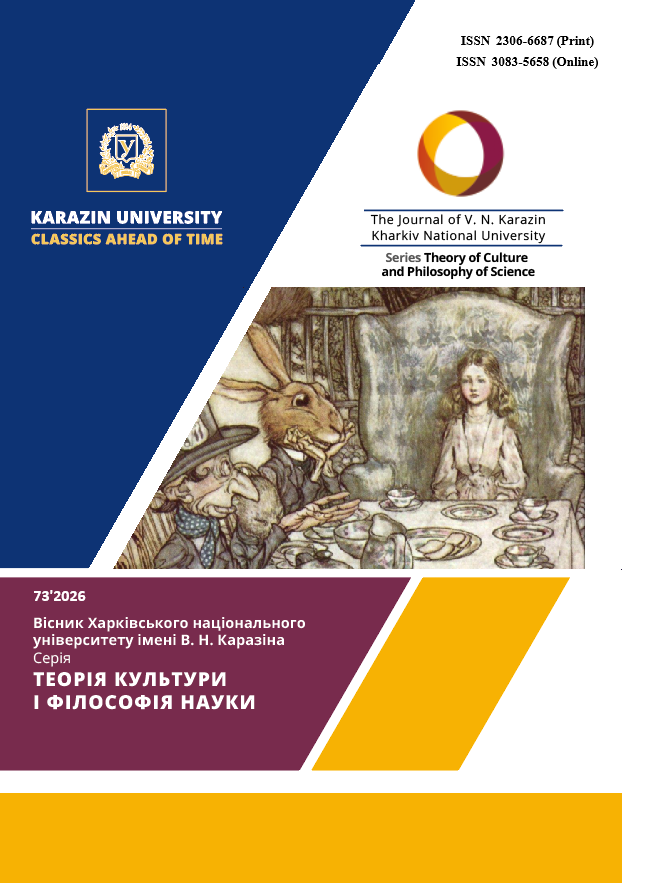
«DOWN THE RABBIT-HOLE»: IMMERSION INTO THE WORLD OF PHILOSOPHY: ON CONTEMPORARY ISSUES OF TEACHING METHODOLOGY
Abstract
The article explores the moment in which philosophy has not yet crystallized into a system of concepts but has already begun to fracture the self-evidence of the world. Taking the first chapter of “Alice’s Adventures in Wonderland and Through the Looking-Glass”as its point of departure, the study reads Carroll’s text not as an introduction to a children’s adventure, but as a topography of entry into thought. The White Rabbit does not invite Alice; he merely disrupts the habitual order of things to such an extent that the world ceases to coincide fully with itself. It is precisely this fracture that becomes the condition for philosophical movement.
The central concept of the article is the dromos – a space of transition that exists only in movement between two states and belongs definitively to neither. The dromos is approached not as a metaphor for the path toward philosophy, but as a form of thinking at the moment of the loss of grounding. Within this space, boredom appears not as a psychological condition, but as a mode of ontological openness; the fall emerges not as a plot device, but as a liminal structure of consciousness; language play functions not as decorative nonsense, but as an experience of entering language prior to understanding it. Alice’s continual changes of scale are interpreted as a crisis of commensurability between subject and world, while Wonderland itself appears as a distinct regime of rationality that exposes the contingency of every order of thought.
Methodologically, the article combines hermeneutic, phenomenological, and problematological,
approaches, drawing on the ideas of G. Deleuze, P. Hadot, H.-G. Gadamer, M. Meyer, M. Foucault, P. Ricoeur V. Turner, and L. Wittgenstein. At the same time, the text deliberately abandons the position of external observation: philosophy is treated not as an object of description, but as an experience into which the reader is already drawn before becoming fully aware of it. In this sense, “Alice’s Adventures in Wonderland and Through the Looking-Glass”is read not as a text requiring definitive interpretation, but as a rhetorical mechanism for destabilizing the self-evident. Carrollian nonsense functions not as the negation of rationality, but as a way of exposing its limits, disrupting the automatisms of thought and forcing consciousness to experience its own instability as a condition of movement.
The article opens a broader cycle of studies devoted to reading L. Carroll as a space of philosophical initiation, where characters, linguistic displacements, rhetorical loops, and the very topography of Wonderland function not as literary images, but as mechanisms for the production of thought
Downloads
References
Alice in Wonderland: Experimental jurisprudence on the internal point of view / Roversi C. et al. Jurisprudence. An International Journal of Legal and Political Thought. 2023. Vol. 14, Issue 2. pp. 143–170. DOI: https://doi.org/10.1080/20403313.2022.2109884
Carroll, L. (2009). Alice’s adventures in Wonderland and Through the Looking-Glass. Oxford University Press.
Deleuze, G. (1990). The logic of sense (M. Lester & C. Stivale, Trans.). Columbia University Press.
Faranda, A. (2022). Alice’s Adventures in Wonderland: A journey into the unconscious, a shamanic journey. *Blue Gum*, *9*, 1–12. https://www.ub.edu/dpfilsa/Blue_Gum/BlueGum_Vol9/9_Faranda%20Blue%20Gum%209%202022.pdf
Foucault, M. (1972). The archaeology of knowledge (A. M. Sheridan Smith, Trans.). Pantheon Books.
Foucault, M. (1977). Discipline and punish: The birth of the prison (A. Sheridan, Trans.). Pantheon Books.
Gadamer, H.-G. (2004). Truth and method (2nd rev. ed., J. Weinsheimer & D. G. Marshall, Trans.). Continuum.
Hadot, P. (1995). Philosophy as a way of life: Spiritual exercises from Socrates to Foucault (A. I. Davidson, Ed.; M. Chase, Trans.). Blackwell.
Hadot, P. (2002). What is ancient philosophy? (M. Chase, Trans.). Harvard University Press.
Heidegger, M. (1995). The fundamental concepts of metaphysics: World, finitude, solitude (W. McNeill & N. Walker, Trans.). Indiana University Press.
Lyotard, J.-F. (1984). The postmodern condition: A report on knowledge (G. Bennington & B. Massumi, Trans.). University of Minnesota Press.
Meyer, M. (1986). Problématologie: Philosophie, science et langage. Presses Universitaires de France.
Nietzsche, F. (1961). Thus spoke Zarathustra (R. J. Hollingdale, Trans.). Penguin Books.
Podolska, T. V., Skryl, O. I. Voices-positions in discourses: how is identity possible? Anthropological Measurements of Philosophical Research, 2017, (11), 23–32. https://doi.org/10.15802/ampr.v0i11.105474
Ricoeur, P. (1981). Hermeneutics and the human sciences: Essays on language, action and interpretation (J. B. Thompson, Ed. & Trans.). Cambridge University Press.
Ricoeur, P. (1984–1988). Time and narrative (Vols. 1-3) (K. McLaughlin & D. Pellauer, Trans.). University of Chicago Press.
Sfetcu N. Alice’s Adventures in Wonderland – Philosophical perspectives. Index Academic. 2025. Vol. 1. pp. 1–11. DOI: https://doi.org/10.58679/IA55823
Turner, V. (1969). The ritual process: Structure and anti-structure. Aldine Publishing.
Wittgenstein, L. (2009). Philosophical investigations (G. E. M. Anscombe, P. M. S. Hacker, & J. Schulte, Trans., Rev. 4th ed.). Wiley-Blackwell.