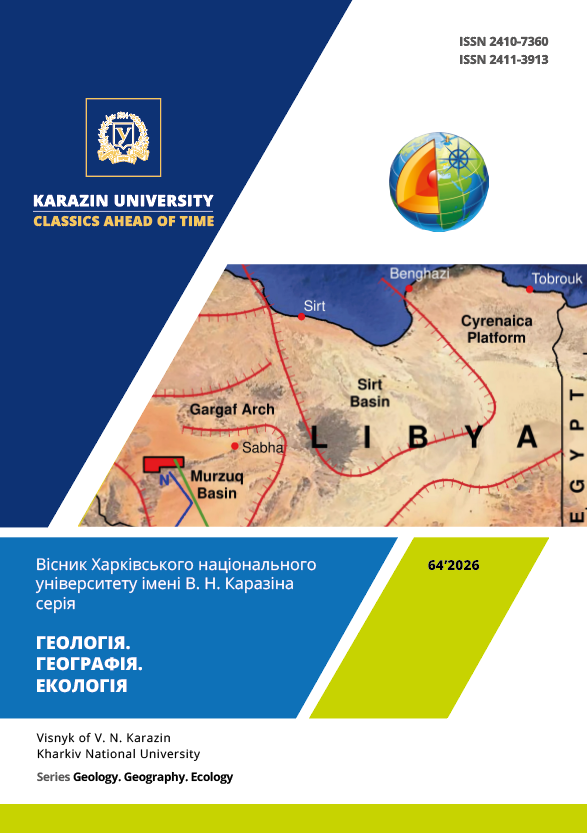
Statistical and 3D Petrophysical Analysis of Reservoir Formations and Net Pay Thickness of the Mamuniyat Formation, Sharara B-Oil Field, Murzuq Basin, Libya
DOI:
https://doi.org/10.26565/2410-7360-2026-64-07Keywords:
Mamuniyat Formation, reservoir characterization, net pay, oil saturation, 3D geostatistical modeling, Murzuq Basin, LibyaAbstract
Problem Statement and Purpose. This study presents a comprehensive statistical analysis and three-dimensional (3D) petrophysical modeling of the Mamuniyat Formation in the Sharara B-Oil Field, Murzuq Basin, Libya. The primary objective is to evaluate reservoir quality and spatial heterogeneity by integrating well-log data with geostatistical simulations using industrystandard petrophysical methods. Through rigorous characterization of effective porosity and fluid saturation distributions, combined with strict net pay cutoff enforcement (Φe ≥ 10%, Vsh ≤ 30%, Sw ≤ 60%), the research identifies the most promising hydrocarbon-bearing zones and establishes a reproducible framework for reservoir evaluation in data-limited settings.
Data and Methods. An integrated statistical and 3D petrophysical characterization was performed based on quantitative analysis of wireline log data from nine wells (B01, B03, B05, B10, B12, B13, B15, B19, B29). Key methodological improvements include effective porosity derived from density logs with shale correction (Φe = Φt × [1−Vsh]) and water saturation calculated using Murzuq Basin-calibrated Archie parameters (Rw = 0.08 Ω·m at 70°C). For wells lacking legacy saturation curves, values were deterministically reconstructed to ensure dataset completeness. Petrophysical properties were spatially distributed using Sequential Gaussian Simulation within a structurally constrained 3D framework, with model accuracy confirmed by blind-well validation. Hydrocarbon Potential Score (HPS). The HPS is a composite multi-criteria index on a 0 to 1 scale, designed for objective reservoir ranking by integrating normalized petrophysical parameters weighted as follows: effective porosity (40%), water saturation (25%), shale volume (15%), total porosity (15%), and net pay thickness (5%). Unfavorable parameters were inverted during normalization to ensure higher scores consistently reflect superior reservoir quality. The HPS was calibrated against volumetric hydrocarbon indicators (net pay thickness × oil saturation) to align quality assessments with actual hydrocarbon column heights.
Results and Discussion. Results reveal pronounced vertical compartmentalization within the Mamuniyat Formation. The Upper Mamuniyat is identified as the primary reservoir target, exhibiting superior fluid properties (average Sw = 31.0%, So = 69.0%), consistent net pay distribution across the field (average thickness 7.1 meters), and the highest HPS score (0.81). The Lower Mamuniyat serves as a secondary target with highly localized commercial potential; its field-wide average net pay thickness is limited to 2.1 meters and confined to structurally elevated zones in the B15 and B29 blocks where hydrocarbon column preservation occurs. Seven wells display minimal Lower Mamuniyat net pay due to proximity to the regional oil-water contact (Sw = 64–75%). The Middle Mamuniyat is consistently non-commercial (average Sw = 82.0%, Φe = 9.2%) and functions as a vertical flow barrier. Corrected volumetric analysis confirms that the Upper Mamuniyat contributes approximately 6.9 times more hydrocarbon volume per well than the Lower Mamuniyat (hydrocarbon column: 4.90 meters versus 0.71 meters), establishing it as the optimal development target.
References
Sobih, N. S., El Nagar, A. A., Abbas, A. E., Shehab, S. (2025). Integrating petrophysical characterization and reservoir evaluation of the Kafr ELSheikh formation in Sapphire field, Nile Delta, Egypt. Scientific Reports, 15, 4627. https://doi.org/10.1038/s41598-025-88056-7
Nabawy, B.S. (2025). New approaches in reservoir characterization utilizing conventional and special core analyses: a comprehensive review. Journal of Umm Al-Qura University for Applied Sciences. https://doi.org/10.1007/s43994-025-00225-6
Belaid, A. (2009). Petroleum Geology of the Murzuq Basin, SWLibya: Geochemical Characterization and Numerical Petroleum Systems Modelling. Aachen: Shaker Verlag.
Saheed, R. M. M., Knudsen, T. Š., Faraj, M. A. M., Nytoft, H. P., Jovančićević, B. (2023). Geochemical Characteristics of Crude Oils from the Sharara-C Oil Field, Murzuq Basin, Southwestern Libya. Journal of Petroleum Geology, 46, 103–123. https://doi.org/10.1111/jpg.12832
Echikh, K., Sola, M. A. (2000). Geology and hydrocarbon occurrences in the Murzuq Basin, SW Libya. In: Sola, M. A., Worsley, D. (Eds.), Geological Exploration in Murzuq Basin. Elsevier Science, Amsterdam, pp. 175–222. https://doi.org/10.1016/B978-044450611-5/50011-8
Azadivash, A., Shabani, M., Mehdipour, V., Rabbani, A. (2023). Deep dive into net pay layers: An in-depth study in Abadan Plain, South Iran. Heliyon, 9(7), e17204. https://doi.org/10.1016/j.heliyon.2023.e17204
Li, L., Yu, J., Huang, T., Tang, L., Wei, D., Li, M., Nie, X. (2025). Integrated net pay cut-off evaluation workflow for tight sandstone reservoirs: a case study of the Linxing gas field, Ordos Basin. Frontiers in Earth Science, 13, 1488079. https://doi.org/10.3389/feart.2025.1488079
Bondarenko, M., Kulyk, V. (2024). Determination of shaliness parameters of terrigenous rocks in cased boreholes and while drilling by radioactive logging combination. Visnyk of V. N. Karazin Kharkiv National University. Series Geology. Geography. Ecology, 61, 10–22. https://doi.org/10.26565/2410-7360-2024-61-01
Al-Mudhafar, W. J., Thanh, V. Q., Wood, D. A., Min, B. (2024). Stochastic lithofacies and petrophysical property modeling for fast history matching in heterogeneous clastic reservoir applications. Scientific Reports, 14, 22. https://doi.org/10.1038/s41598-023-50853-3
Radwan, A. E., Nabawy, B. S., Kassem, A. A., Hussein, W. S. (2021). 3D integrated structural, facies and petrophysical static modeling approach for complex sandstone reservoirs: A case study from the Coniacian–Santonian Matulla Formation, July Oilfield, Gulf of Suez, Egypt. Natural Resources Research, 30, 3719–3748. https://doi.org/10.1007/s11053-021-09980-9
Hallett, D., Clark-Lowes, D. (2016). Petroleum geology of Libya. Elsevier Inc., Amsterdam
Shalbak, F. A. (2015). Palaeozoic petroleum systems of the Murzuq Basin, Libya (Master’s thesis). University of Barcelona. https://diposit.ub.edu/dspace/bitstream/2445/103316/1/FAS_THESIS.pdf
Saadi, N., Elkoul, O., Sadeg, S. A. (2023). Integrating remote sensing and aeromagnetic data for lithological and structural lineaments mapping in Abu Ghaylan – Kiklah – Tighrinna, northwest Libya. Visnyk of V. N. Karazin Kharkiv National University. Series Geology. Geography. Ecology, 58, 97–110. https://doi.org/10.26565/2410-7360-2023-58-08
Conant, L. C., Goudarzi, G. H. (1967). Stratigraphic and Tectonic Framework of Libya. AAPG Bulletin, 51(4), 719–730. 10.1306/5D25C0C9-16C1-11D7-8645000102C1865D
Lüning, S., Craig, J., Loydell, D. K., Storch, P., Fitches, B. (2000). Lower Silurian “hot shales” in Northern Africa and Arabia: regional distribution and depositional model. Earth-Science Reviews, 49(1-4), 121–200. https://doi.org/10.1016/S0012-8252(99)00060-4
Bellini, E., Massa, D. (1980). A stratigraphic contribution to the Paleozoic of the southern basins of Libya. In M. J. Salem & M. T. Busrewil (Eds.), The Geology of Libya I (pp. 3–56). Academic Press.
Fello, N. M. (2001). Depositional environments, diagenesis and reservoir modelling of Concession NC115, Murzuq Basin, SW Libya (PhD Thesis). Durham University.
Mohamed, A. K., Beshr, A. M. (2022). Petrophysical properties of the Mamuniyat Formation for hydrocarbon potentiality in “A” Oil Field, NC115 Concession of Murzuq Basin, Libya. Arabian Journal of Geosciences, 15, 447. https://doi.org/10.1007/s12517-022-09657-4
Hassan, H. S., Kendall, C. C. (2014). Hydrocarbon provinces of Libya: a petroleum system study. In L. Marlow, C. Kendall, & L. Yose (Eds.), Petroleum Systems of the Tethyan Region: AAPG Memoir 106 (pp. 101–141). https://doi.org/10.1306/13431855M1063608
El Diasty, W. Sh., El Beialy, S. Y., Anwari, T. A., Peters, K. E., Batten, D. J. (2017). Organic geochemistry of the Silurian Tanezzuft Formation and crude oils, NC115 Concession, Murzuq Basin, southwest Libya. Marine and Petroleum Geology, 86, 367– 385. https://doi.org/10.1016/j.marpetgeo.2017.06.002
El Diasty, W. Sh., El Beialy, S. Y., Anwari, T. A., Batten, D. J. (2017). Hydrocarbon source potential of the Tanezzuft Formation, Murzuq Basin, south-west Libya: An organic geochemical approach. Journal of African Earth Sciences, 130, 102–109. https://doi.org/10.1016/j.jafrearsci.2017.03.005
Belaid, A., Krooss, B. M., Littke, R. (2010). Thermal history and source rock characterization of a Paleozoic section in the Awbari Trough, Murzuq Basin, SW Libya. Marine and Petroleum Geology, 27(3), 612–632. https://doi.org/10.1016/j.marpetgeo.2009.06.006
Davidson, L., Beswetherick, S., Craig, J., Eales, M., Fisher, A., Himmali, A., Jho, J., Mejrab, B., Smart, J. (2000). The structure, stratigraphy and petroleum geology of the Murzuq Basin, Southwest Libya. In Geological Exploration in Murzuq Basin (pp. 295–320). Elsevier. https://doi.org/10.1016/b978-044450611-5/50016-7
Galushkin, Yu. I., Eloghbi, S. (2014). Thermal history of the Murzuq Basin, Libya, and generation of hydrocarbons in its source rocks. Geochemistry International, 52(6), 486–499. https://doi.org/10.1134/s0016702914060032
Abukliesh, M., Mostafa, T., Zein El Din, M. Y., Abdelhafeez, T. H. (2024). 3D Seismic Data Interpretation and Static Reservoir Modeling of Mamuniyat Formation, I and R Oil Fields, Murzuq Basin, Libya. The Iraqi Geological Journal, 275–286. https://doi.org/10.46717/igj.57.1e.18ms-2024-5-29
Aziz, A. (2000). Stratigraphy and hydrocarbon potential of the Lower Palaeozoic succession of License NC-115, Murzuq Basin, SW Libya. In Geological Exploration in Murzuq Basin (pp. 349– 368). Elsevier. https://doi.org/10.1016/b978-044450611-5/50018-0
Selim, E. S. I., Kamel, A., Kashlaf, A. (2014). Hydrocarbon probability of Middle Ordovician Hawaz Formation, Murzuq Basin, Southwestern Libya. Arabian Journal of Geosciences, 8(8), 5531– 5560. https://doi.org/10.1007/s12517-014-1633-2
Gil-Ortiz, M., McDougall, N. D., Cabello, P., Marzo, M., Ramos, E. (2022). Sedimentary architecture of a Middle Ordovician embayment in the Murzuq Basin (Libya). Marine and Petroleum Geology, 135, 105339. https://doi.org/10.1016/j.marpetgeo.2021.105339
Smart, J. (2000). Seismic expressions of depositional processes in the upper Ordovician succession of the Murzuq Basin, SW Libya. In Geological Exploration in Murzuq Basin (pp. 397–415). Elsevier. https://doi.org/10.1016/b978-044450611-5/50021-0
Bataller, F. J., McDougall, N. D., Moscariello, A., Gil-Ortiz, M., Cavalcanti de Paula, B. (2021). Late Ordovician deglaciation of the Murzuq Basin (SW Libya): a core to seismic-scale characterization of the depositional environments and sedimentary architecture. Marine and Petroleum Geology, 134, 105335. https://doi.org/10.1016/j.marpetgeo.2021.105335
Abukliesh, M., Mostafa, T., Zein El Din, M. Y., Abdelhafeez, T. H. (2024). Integrating well logs and core data for better reservoir characterization of Mamuniyat Formation, Murzuq Basin, Libya. The Iraqi Geological Journal, 57(1A), 1–10. https://doi.org/10.46717/igj.57.1A.1ms-2024-1-12
Archie, G. E. (1942). The Electrical Resistivity Log as an Aid in Determining Some Reservoir Characteristics. Petroleum Transactions of the AIME, 146(1), 54–62. https://doi.org/10.2118/942054-G
McDonald, A. (2021). Data quality considerations for petrophysical machine-learning models. Petrophysics, 62(6), 585–613. 10.30632/PJV62N6-2021a1
GhojehBeyglou, M. (2021). Geostatistical modeling of porosity and evaluating the local and global distribution. Journal of Petroleum Exploration and Production Technology, 11(10), 4227–4241. https://doi.org/10.1007/s13202-021-01308-w
Sola, M. A., Worsley, D. (2000). Geological Exploration in Murzuq Basin. Elsevier, Amsterdam, 519 p.